
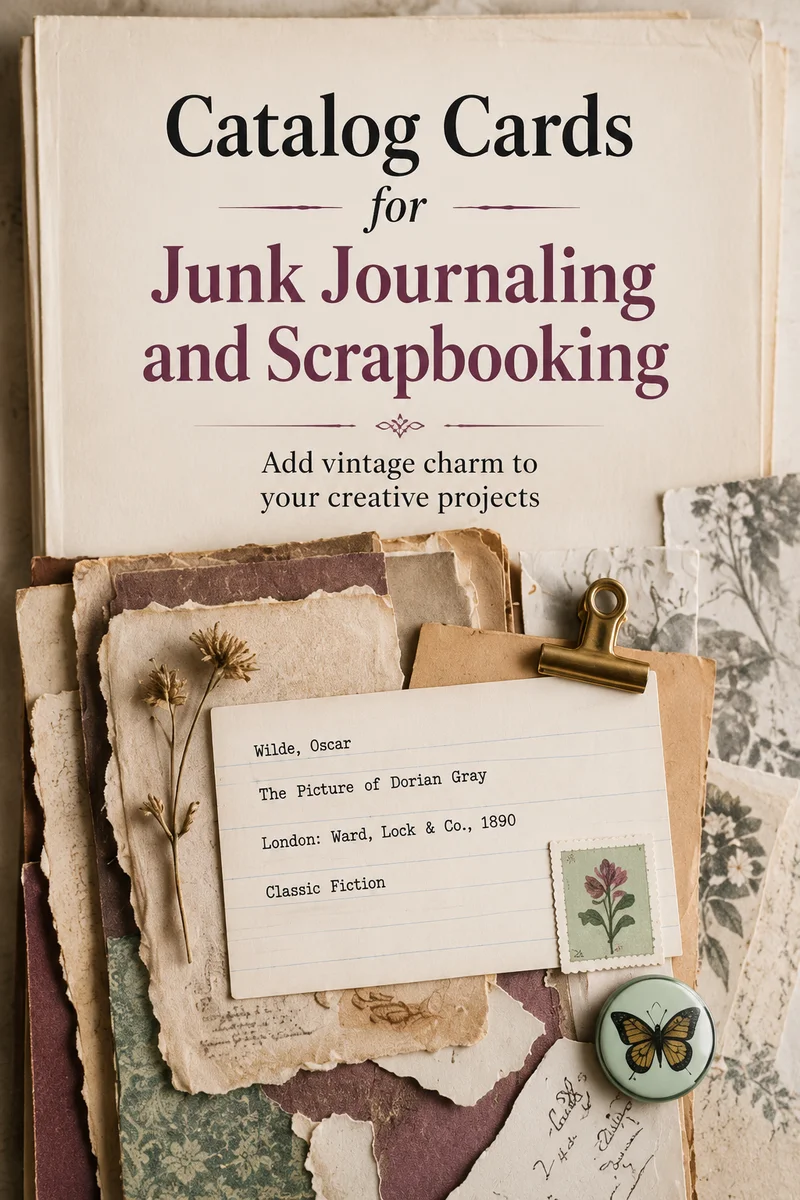
There is something irresistible about a catalog card to a junk journaler. It arrives pre-aged in spirit — formal Dewey Decimal lines, a typewriter font, that faint suggestion of a library basement in 1962. Layered into a spread with washi tape and pressed flowers, it stops looking like a filing system and starts looking like a found object. The good news is that you do not have to haunt estate sales to collect them. A free printable generator and a pack of heavyweight cardstock will give you as many as you want, in whatever style suits your current spread.
Want to make your own? Try the free generator
Why Catalog Cards Are Perfect Ephemera
Ephemera works in junk journaling because it carries the suggestion of a life that was lived before the page. Vintage receipts, ticket stubs, old envelopes — they all hint at a story. A catalog card does the same thing with extra efficiency, because it already looks like a document. The structured lines and the library typography give a spread an archival quality that is very hard to manufacture from scratch.
Catalog cards also happen to be exactly the right size. At three by five inches, they slot neatly into pockets, tuck under washi tape, layer behind photos, and fold into tags without a single cut. They fill a spread without overwhelming it. When you print them on cream or ivory cardstock rather than bright white, the vintage effect is immediate.
Filling In the Fields — or Not
One of the choices you get to make with catalog cards as junk journal ephemera is how much to fill them in. You can use the free catalog card generator to print a card that already has a title, author, and call number — a real or invented book, a fictional character, a poem title that fits the theme of your spread. A card for a book called Field Notes on Leaving by someone named E. Margolies, call number 811.6, reads as completely convincing even though neither the book nor the author exists.
You can also print blank or nearly blank cards and fill in details by hand, which adds a layer of texture that printed text cannot match. A mix of both — some printed cards, some hand-lettered — gives a spread the layered, accumulated feeling that is the whole point of the genre. The lines on a catalog card guide your handwriting without constraining it, which makes them easier to write on than plain paper.
Ways to Use Catalog Cards in a Spread
The most common use is as a pocket insert: fold the card slightly and tuck it into a library-card pocket (also printable from the generator), leaving a corner visible. This adds dimension and an interactive element — the viewer can pull out the card and read what is on it. Fill the back with a handwritten note, a quote, a date, a memory. The pocket becomes a small envelope of meaning.
Other uses worth trying include using a catalog card as a title block for a spread, layering it flat under a semi-transparent vellum sheet, cutting it into tags with a small hole punch and a length of twine, using the back as a journaling surface, or grouping three or four cards in a row to form a timeline or a sequence. A string of catalog cards clipped to a twine line across two pages makes an elegant banner that doubles as a hidden journaling spot.
Scrapbooking Applications
In traditional scrapbooking, catalog cards work best as supporting elements rather than focal points. A photo of a bookshelf or a library visit lands differently when a real catalog card from the generator sits beside it, especially if the card is filled out for an actual book that appears somewhere in the photo. It ties the document to the image in a way that a printed label never quite does.
For family history scrapbooking, catalog cards take on a particular resonance. Fill one out for a relative's favorite book, for a book that was passed down in the family, or for the title of a journal you found in a box of old papers. It is the kind of detail that makes a layout feel researched rather than assembled.
Getting the Look Right
Paper choice matters more than almost anything else. Printing catalog cards on bright white copy paper flattens the vintage effect immediately. Print on cream or natural-toned heavy cardstock and the difference is significant. If you are tea-staining your pages, a catalog card takes the treatment well — the fibers absorb the color evenly and the printed lines stay readable.
Distressing the edges with an ink pad or tearing them slightly before adhering to a spread is optional but effective. A lightly distressed catalog card reads as genuinely old rather than decoratively old. The generator lets you print as many cards as you need, so experiment freely — the stakes of a single card are low enough to try whatever occurs to you.
Start With One Spread
Print a small batch of cards — eight to ten is plenty to start — on good cream cardstock and bring them to your work table with no specific plan. Lay them against a spread in progress and see where they want to go. They will almost certainly find a place. Catalog cards are, at their best, a very cooperative kind of ephemera: structured enough to anchor a busy layout, understated enough to not compete with anything else on the page.
Helpful supplies for your junk journal projects
Some links on this page are affiliate links. If you purchase through them, we may earn a small commission at no extra cost to you.
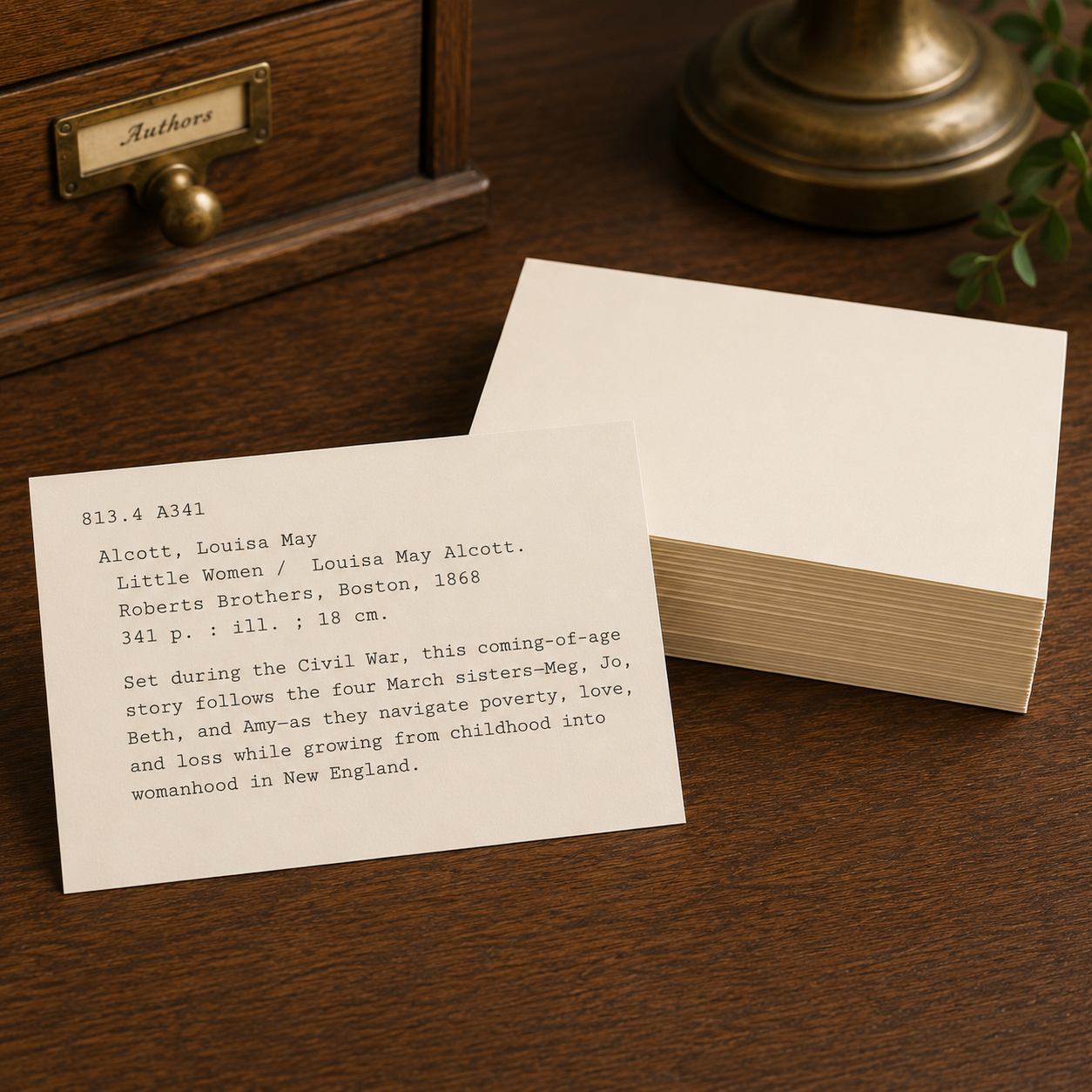
Heavy blank cards for printing catalog cards with a warm vintage look.


Wooden card catalog drawer with dividers for storing printed catalog cards.
Ready to make your own catalog card ephemera?
Print as many catalog cards as you need — free, in your browser, no sign-up required.
Open the generator