
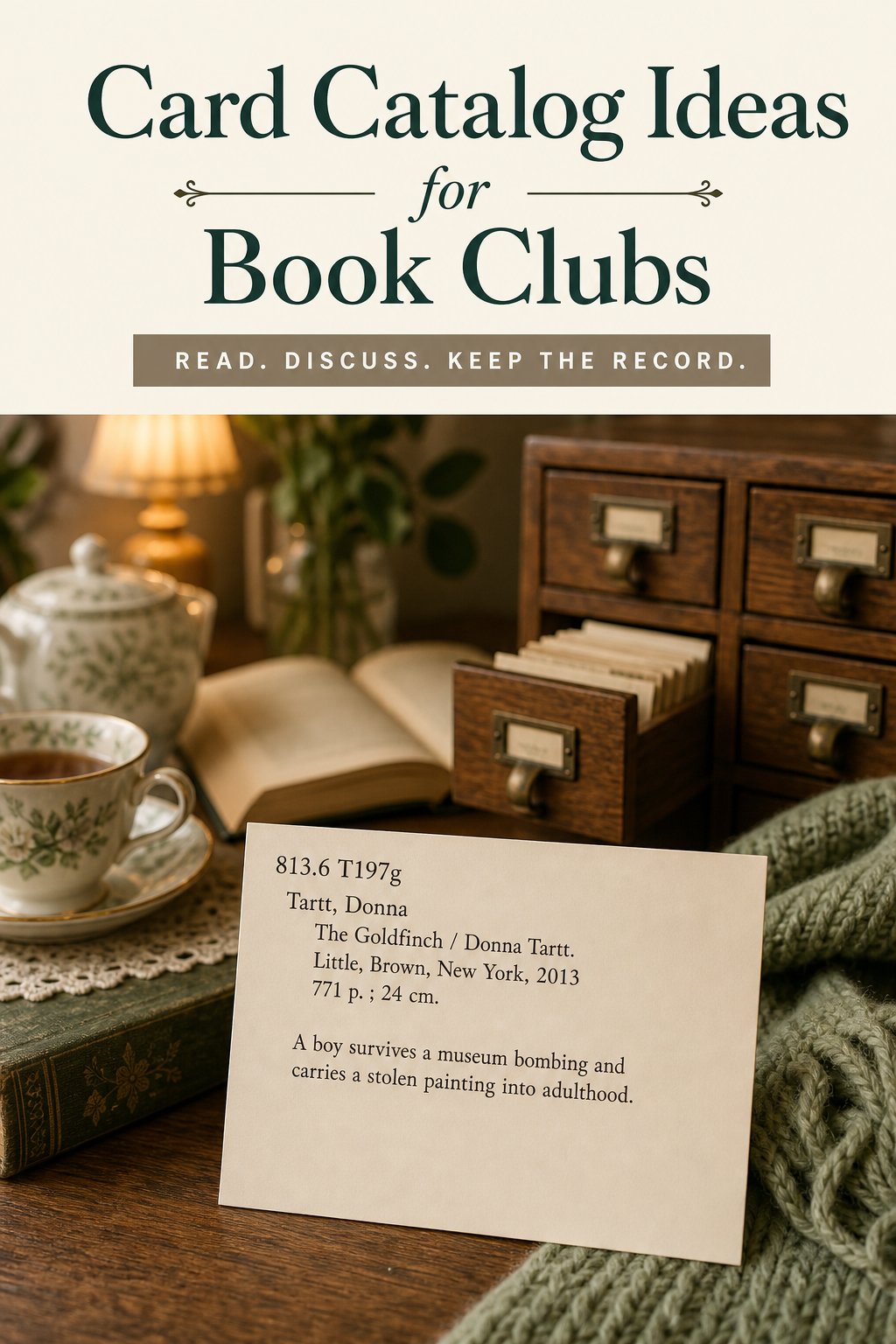
Most book clubs keep their history somewhere scattered: a group text nobody can scroll back far enough in, a shared doc that got abandoned in month three, a spreadsheet someone made once and never opened again. A card catalog fixes that in the most low-tech way possible, and it turns out to be more fun than any app, because there's something to actually hold at meetings.
Want to make your own? Try the free generator
Why Use a Card Catalog Instead of a Spreadsheet?
A spreadsheet works fine for one person tracking their own reading, but a book club is a group of people who each want a hand in the record, and a shared spreadsheet quietly becomes one person's job within a month or two. A card box passed around at meetings spreads that work out naturally. Whoever hosted last time fills in that month's card before handing the box to the next host, and no single member ends up as the unofficial club secretary forever.
It also gives the club something to do with its hands during the slow first ten minutes of a meeting, before everyone's arrived and the real discussion starts. Flipping through old cards, laughing about a book the group hated, remembering who brought snacks the month you read that one very long novel, that's a small ritual that a shared link on a phone just doesn't create in the same way.
Build a Pick History Card for Every Selection
The simplest use of a card catalog for a book club is also the most valuable one over time: a card for every book you've read together. Include the title, author, the month you read it, who nominated it, and a line for group consensus, loved it, mixed, or skip. After a year or two this stack becomes genuinely useful. New members can flip through it to catch up on the club's taste. Long-standing members can settle the inevitable "wait, did we already read this author" debate in about four seconds.
Keep the pick history cards in one dedicated section of the box, filed by the date you read them rather than alphabetically, so the stack reads like a timeline of the club itself. It becomes a small, unexpected record of a friendship built around books.
Track Nominations and Voting
If your club picks books by nomination and vote, catalog cards make the process visible instead of buried in a chat thread. Have each member fill out a nomination card with the title, why they're suggesting it, and roughly how long it is. Lay the cards out at the meeting, let everyone vote, and file the winner into the pick history section. The losing nominations don't have to disappear either. Keep an "on deck" divider and slide them behind it for next time, so good suggestions never get lost just because they didn't win once.
Give Every Member Their Own Reading Card
This one turns into a keepsake. Print a card for each member of the group with their name at the top, and use it to log which meetings they made it to, which books they finished versus skimmed versus didn't finish (no judgment, it happens), and a favorite quote or line they brought to discussion. A club that's been meeting for a few years ends up with a small personal archive for every member, something genuinely lovely to hand someone if they move away or the club eventually disbands.
Use the free catalog card generator to keep these looking consistent across the group. A uniform template makes the whole box feel intentional rather than like loose scraps of paper, and it means anyone in the club can make a new card without having to match someone else's handwriting or layout by eye.
What Makes a Good Discussion Question Card?
Whoever hosts or leads discussion for a given book can prep three or four question cards ahead of time instead of relying on memory or a printout that gets lost by the next meeting. File these behind the pick history card for that book, so if your club ever revisits an author or wants to loan out a "starter kit" for a title to another group, the discussion questions travel with it. It also means a shy host who's nervous about leading discussion has something concrete to hold onto, literally.
A Shared Physical Object Beats a Shared Link
There's a practical case for this beyond nostalgia. Group chats get long and searchable-in-theory-only. Shared docs quietly rot when nobody remembers the link. A physical card box, kept by whoever hosts most often or passed between members month to month, doesn't have any of those failure points. You open it, and the whole history of the club is right there in a stack you can flip through by hand.
If your club is spread across cities or meets virtually, this still works. One member keeps the physical box and photographs cards to share when someone asks "wait, when did we read that one." It's a small, low-effort system, and it tends to outlast every app your club has tried and quietly stopped using.
Ratings and Reactions, Without the Awkward Star System
Star ratings flatten a conversation that's usually more interesting than a number. Instead, use a small line on each pick history card for a one-word group reaction: "divisive," "unanimous favorite," "better than expected," "we argued for an hour." This is more honest about what actually happened at the meeting than a five-star average ever could be, and it's a genuinely fun thing to read back over after twenty or thirty books.
Some clubs like to add a small tally, a quick show of hands recorded as a fraction, "6 of 8 would recommend it," right on the card. It takes ten seconds at the end of a meeting and gives you real data if you ever want to look back and figure out what kind of books your club actually loves versus what kind you keep picking out of obligation.
What Should Go in a New Member's Starter Kit?
When someone new joins the club, a stack of catalog cards does a better job of welcoming them than a rushed verbal recap. Pull together a small starter kit: five or six pick history cards from the club's biggest hits, a card explaining how nominations and voting work, and a blank member card for them to start filling in themselves. It takes fifteen minutes to assemble and it makes a new member feel like they've actually joined something with a history, not just showed up to a meeting already in progress.
For clubs that meet at a rotating host's house each month, consider printing an extra set of "on deck" and "pick history" cards so the traveling box always has a current snapshot even if the master archive stays with one person. Use the free catalog card generator to keep the starter kit and the master archive looking identical, so nothing feels like a knockoff copy.
Seasonal or Themed Sections
If your club does themed months, holiday reads, banned books, translated fiction, a summer beach read, give those their own divider in the box. It makes planning next year's calendar much easier, since you can flip straight to "what did we read for the holidays the last three years" instead of trying to remember. It also turns into a nice tradition of its own: a themed section that grows every year becomes something the club looks forward to adding to, not just a record of what already happened.
Start with just the pick history cards if the rest feels like too much. Even that one habit, one card per book, read consistently, turns into something your whole club will be glad exists a few years from now.
Helpful supplies for your book club's card box
Some links on this page are affiliate links. If you purchase through them, we may earn a small commission at no extra cost to you.
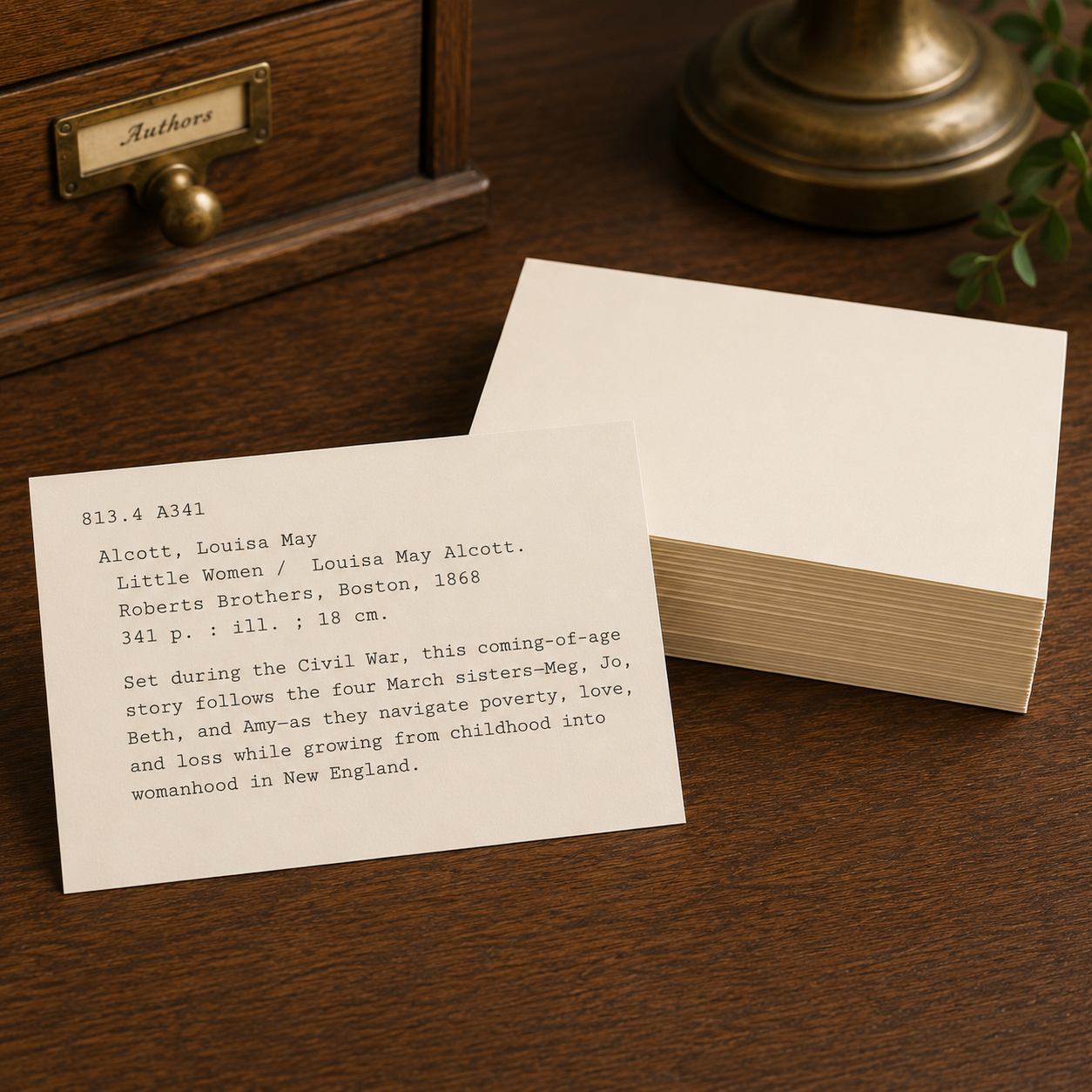
Heavy blank cards for printing pick history and member cards with a warm vintage look.


A clean box for passing between members and holding a full year of picks.
Ready to start your catalog?
Generate printable library catalog cards for your book club's next meeting.
Open the generator