
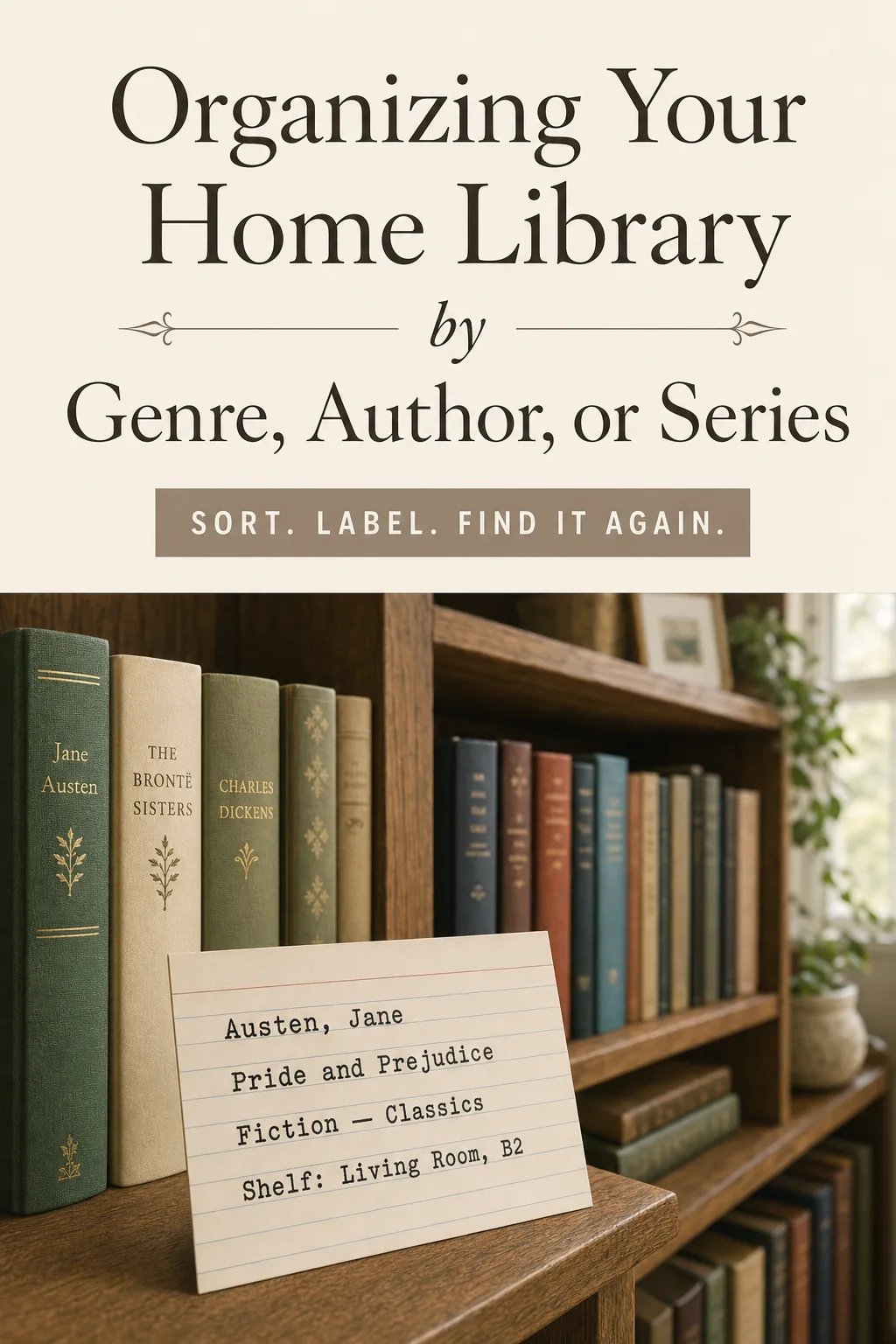
Every home library eventually asks you a question you have to answer honestly: how do you actually look for a book when you want one? Some people picture a name. Some picture a mood, a shelf, a color of spine. There's no single correct filing system for a personal collection, but there is a correct one for you, and once you find it, the whole shelf stops feeling like clutter and starts feeling like a library.
Want to make your own? Try the free generator
Sorting by Genre
Genre sorting works well if you read across a wide range of subjects and tend to shop your own shelves by mood. You reach for "something in mystery" the same way you'd browse a bookstore section, and having your books grouped that way mirrors how your brain already works. The tricky part is deciding where the edge cases go. A historical mystery with romance elements could live in three different sections depending on your mood the day you shelved it, so the fix is to pick one home shelf and let the catalog card do the cross-referencing for you.
On each card, note the primary genre in the top corner and add a small "also" line underneath for secondary genres. That way the book only lives in one physical spot, but you can flip through your card box under "Romance" and still find the historical mystery that has a slow-burn love story in it, because its card is filed there too as a cross-reference. This is exactly what real libraries do with subject headings, just scaled down to fit a desk drawer.
Sorting by Author
Author sorting is the simplest system to maintain and the easiest for guests to understand without an explanation. It's the natural choice if you collect an author's full backlist, if you read mostly fiction, or if you just find genre labels more trouble than they're worth. File by last name, and if you own multiple books by the same author, order those alphabetically by title within that author's section.
The one place author sorting struggles is nonfiction, where you're more likely to go looking for a subject than a name. If your shelves mix a good amount of nonfiction in with fiction, consider a hybrid: fiction by author, nonfiction by subject, with a divider card marking where one system ends and the other begins. Your catalog cards can carry a "Fiction" or "Nonfiction" tag in the corner so the card box mirrors the shelf split exactly.
Sorting by Series
If a large share of your collection is series fiction, fantasy sagas, long-running mysteries, middle grade series your kids are working through, sorting by series first and author second solves a problem the other two systems don't: reading order. A series shelved alphabetically by author still keeps the books together, but a card catalog built around series makes it obvious at a glance whether you own book four and are missing book five.
Give each series its own set of cards, numbered in reading order rather than alphabetized by title, and note the series name and number clearly on every card, something like "Series: Six of Crows, Book 2 of 2." This is also the sorting method that pays off most when you're gifting or lending. A friend borrowing "book one" can hand back the card, and you'll know instantly which book is out and which one is next.
Using Catalog Cards to Bridge Systems
The honest truth is most home libraries end up as a blend. You might shelve fiction by author, keep a small standalone genre section for cookbooks and craft books, and pull series fantasy into its own corner because it looks nice grouped together on the shelf. Catalog cards are what make a blended system actually work, because the card, not the shelf, is where the real information lives. The shelf just needs to look good and be easy to browse. The card is what tells you everything else: genre, series position, acquisition date, whether it's out on loan.
A good template makes this painless. Use the free catalog card generator to produce clean, consistent cards no matter which system, or combination of systems, you land on. Print a stack, fill them out as you sort, and file them by whichever field matters most to you: author last name, genre, or series title. You can always print a second card for a book and file it under a second heading too, the same trick real reference libraries have used for a century.
Which System Is Right for Your Household?
If you're sorting a shared or family library, ask everyone how they actually search before you commit to a system. A partner who reads mostly nonfiction and a kid who's obsessed with one nine book fantasy series are going to want to browse completely differently, and a single rigid system tends to frustrate at least one of them. Genre works well for households with wide, varied reading tastes. Author works well for households that lean fiction and know their favorite writers by name. Series works well anywhere a lot of reading happens in order, especially with younger readers who need to know what comes next.
Whatever you choose, write it down. A single index card at the very front of the box explaining "Fiction is by author, nonfiction is by subject, series fantasy has its own section near the window" saves everyone, including future you, from re-litigating the system every few months.
What Should You Put on a Catalog Card?
Regardless of which sorting method you pick, the card format underneath it can stay consistent. Put the title and author at the top in the largest text, since your eye needs to find those first no matter what. Below that, a small block for the fields that matter to your system: genre and secondary genre if you're sorting by subject, series name and number if you're tracking a saga, publication year if that matters to you. Leave a line for a personal note, because the note is usually the part people end up treasuring most a few years later.
Resist the urge to cram every possible field onto one card. A catalog card that tries to hold ten pieces of information becomes cluttered and slow to read at a glance, which defeats the purpose of a quick reference system. Pick the three or four fields that actually help you find a book faster, and let everything else live in a longer note if you want it recorded at all.
How Do You Reshelve as Your Collection Grows?
No system survives contact with a growing collection unchanged. What starts as a tidy genre split can outgrow itself once you own forty mystery novels and only three books in general fiction. When a section gets crowded enough that browsing it stops being fast, that's your signal to split it: mystery becomes cozy mystery and thriller, fantasy becomes epic fantasy and contemporary fantasy, whatever divide actually matches your shelves.
This is another place a card catalog beats trying to reorganize the physical shelf constantly. You can resort your card box in an afternoon, refile everything under the new subdivisions, and only move the actual books once you're confident the new split is going to stick. Treat the cards as your drafting space and the shelf as the final, settled layout.
Teaching the System to Guests and Family
A sorting system only pays off if the people who use your library, not just you, can navigate it. If your card catalog uses a system that isn't self-explanatory (color-coded genre dots, a numbering scheme for series order), a quick key card at the front of the box goes a long way. Anyone browsing can learn the shorthand in about thirty seconds instead of asking you to translate it every time.
This matters even more if your library gets used by kids or by a rotating cast of house guests who borrow books. A clear, well-labeled system means fewer misfiled returns and fewer books that quietly wander off because nobody was sure where they belonged in the first place. Sorting a library isn't really about picking the perfect method. It's about picking a method you'll actually keep using, and giving yourself the tools, like a simple card catalog, to keep it honest over time.
Helpful supplies for sorting your home library
Some links on this page are affiliate links. If you purchase through them, we may earn a small commission at no extra cost to you.
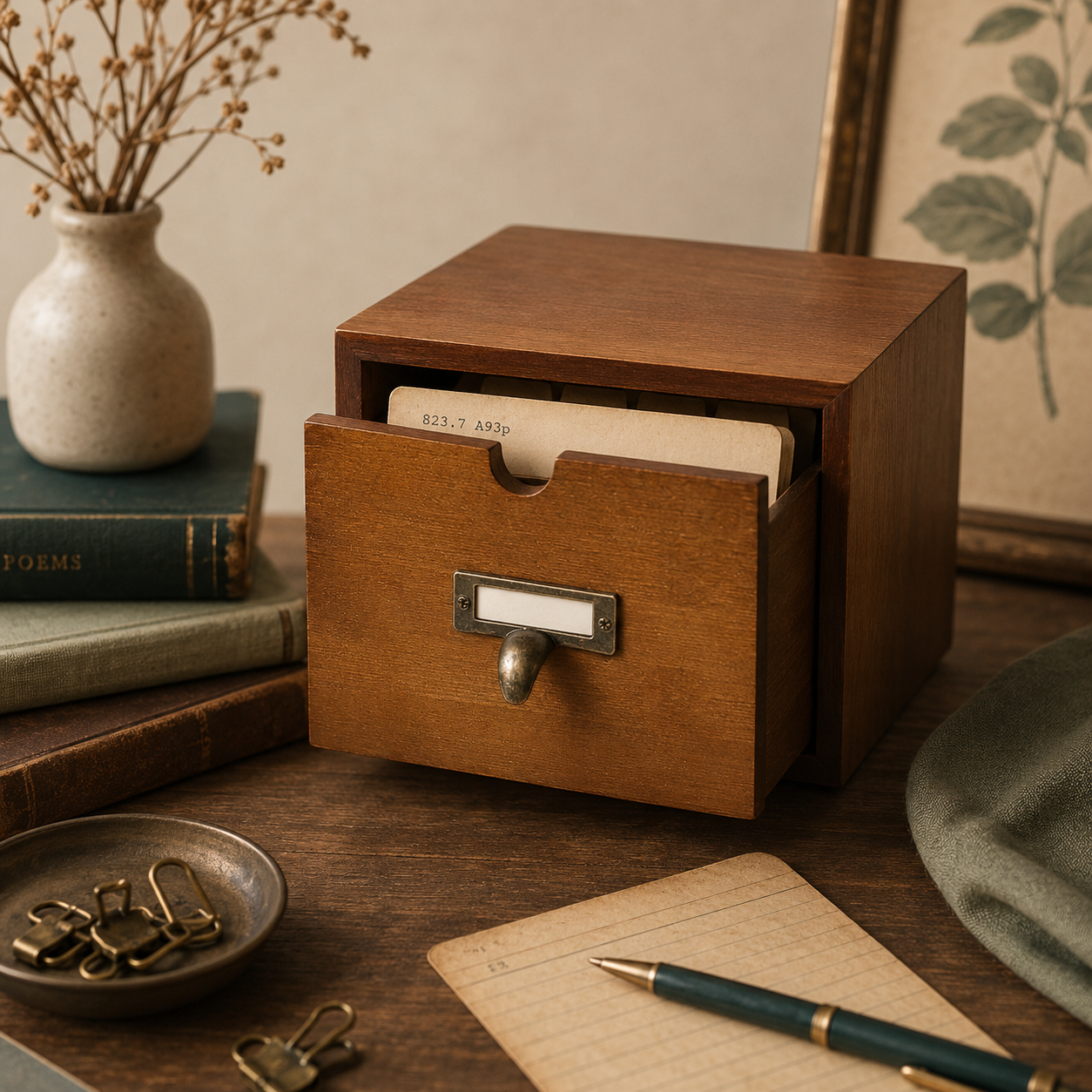
Wooden card catalog drawer with dividers for filing cards by genre, author, or series.

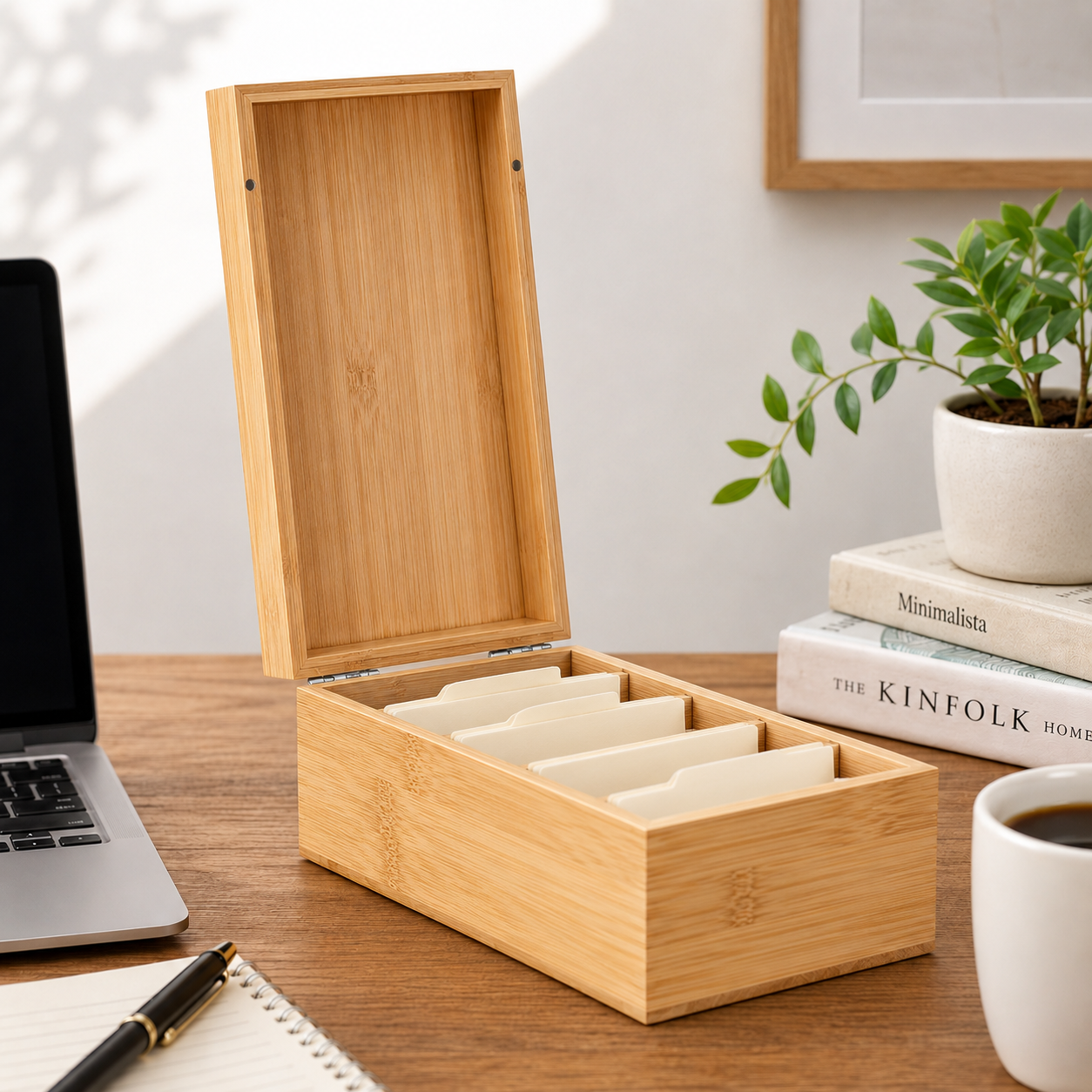
A clean desktop box with dividers for splitting a growing collection into sections.
Ready to start your catalog?
Generate printable library catalog cards for every book in your home library.
Open the generator